Tag: Chrome

One Extension Could Hijack AI Assistants Across Chrome, Comet, Edge, Opera Neon and Claude
News

One Extension Could Hijack AI Assistants Across Chrome, Comet, Edge, Opera Neon and Claude

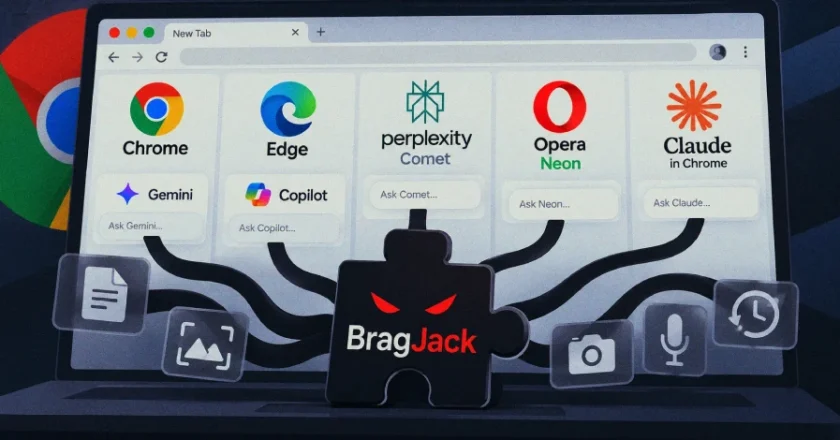
The AI assistants included in five Chromium-based products—Gemini Live in Chrome, Perplexity Comet, Microsoft Edge, Opera Neon, and the Claude in Chrome extension—could be taken over by a single standard browser extension, according to security researchers at Forever Security. With only one click, each product's built-in AI could be accessed once the extension was installed. It could instruct the AI agent to act on behalf of the attacker on Comet, Edge, Opera Neon, and Claude in Chrome; it could read data from the user's PC on Comet and Chrome, and it could activate the microphone and camera on Chrome. The results are researcher demonstrations rather than real-world assaults, and each one necessitates that the victim's browser already have the attacker's extension installed. Each...
New Chrome Zero-Day (CVE-2026-2441) Under Active Attack — Patch Released
News

New Chrome Zero-Day (CVE-2026-2441) Under Active Attack — Patch Released

Google fixed a security hole in its Chrome browser that it claimed has been exploited in the wild on Friday by releasing security upgrades. Known as CVE-2026-2441 (CVSS score: 8.8), the high-severity vulnerability has been characterized as a CSS use-after-free flaw. Shaheen Fazim, a security researcher, is recognized for having identified and reported the vulnerability on February 11, 2026. According to a description of the vulnerability in NIST's National Vulnerability Database (NVD), a remote attacker could execute arbitrary code inside a sandbox via a crafted HTML site if Google Chrome's CSS was used after free before 145.0.7632.75. Google admitted that there is an attack for CVE-2026-2441 in the wild, but it did not reveal any information about how the vulnerability is being ...
New Chrome Vulnerability Enables Cross-Origin Data Leak via Loader Referrer Policy
News

New Chrome Vulnerability Enables Cross-Origin Data Leak via Loader Referrer Policy

Google fixed four security flaws in its Chrome browser on Wednesday, including one for which it claimed there was an exploit in the wild. CVE-2025-4664, a high-severity vulnerability with a CVSS score of 4.3, has been described as an instance of inadequate policy enforcement in a component known as Loader. A summary of the vulnerability states that "a remote attacker was able to leak cross-origin data via a crafted HTML page due to inadequate policy enforcement in Loader in Google Chrome prior to 136.0.7103.113." The tech giant acknowledged that an attack for CVE-2025-4664 is in the wild and gave credit to security researcher Vsevolod Kokorin (@slonser_) for describing the X vulnerability on May 5, 2025. Chrome resolves the Link header on sub-resource requests, in contrast to ...
Firefox continues Manifest V2 support as Chrome disables MV2 ad-blockers
News

Firefox continues Manifest V2 support as Chrome disables MV2 ad-blockers

Mozilla has reaffirmed its commitment to support Manifest V2 extensions in addition to Manifest V3, allowing users to use any extensions they like within their browser. A browser extension protocol called Manifest V3 was created by Google with the goal of limiting excessively permissive network queries and remote content loading in order to make add-on functionality in web browsers safer. Notwithstanding the goals, Manifest V3 restricts some add-ons, such as ad-blockers, which may make them less useful. As the implementation of Manifest V3 enforcement progresses, browser extensions that are incompatible with it are being removed read more about Firefox continues Manifest V2 support as Chrome disables MV2 ad-blockers. Get up to date on the latest cybersecurity news and enhance ...
Google to Block Entrust Certificates in Chrome Starting November 2024
News

Google to Block Entrust Certificates in Chrome Starting November 2024

Citing compliance failures and the certificate authority's slow response to security vulnerabilities, Google has announced that it will begin blocking websites that use Entrust certificates starting on or around November 1, 2024, in its Chrome browser. Google's Chrome security team stated that over the past few years, publicly available incident reports have shown a pattern of unsettling actions by Entrust that do not live up to the expectations mentioned above. This has damaged public trust in Entrust's ability, dependability, and integrity as a publicly trusted [certificate authority] owner. In light of this, the massive tech company announced that it will default to not trust TLS server authentication certificates from Entrust beginning read more about Google to Block Entrust Cer...
Zero-Day Alert Update Chrome Now to Fix New Actively Exploited Vulnerability
News

Zero-Day Alert Update Chrome Now to Fix New Actively Exploited Vulnerability

Updates for Google's Chrome browser, which addresses four security flaws including an active zero-day vulnerability, were made available on Tuesday. Threat actors may be able to use the problem, which is tracked as CVE-2024-0519, to cause a crash by taking advantage of an out-of-bounds memory access in the V8 JavaScript and WebAssembly engine. According to MITRE's Common Weakness Enumeration (CWE), an attacker may be able to obtain secret values, such as memory addresses, by reading out-of-bounds memory. These values can then be used to get around security measures like ASLR and increase the likelihood of successfully exploiting a different danger to achieve code execution read more Zero-Day Alert Update Chrome Now to Fix New Actively Exploited Vulnerability. Get up to date o...
New Chrome Zero-Day Vulnerability Exploited in the Wild – Update ASAP
News

New Chrome Zero-Day Vulnerability Exploited in the Wild – Update ASAP

Google has released security patches for the Chrome browser to fix a zero-day vulnerability of high severity that it claims has been used in the wild. The WebRTC framework contains a heap-based buffer overflow vulnerability that has been given the CVE identification CVE-2023-7024. It has been described as a vulnerability that might be exploited to cause software crashes or arbitrary code execution. On December 19, 2023, Clément Lecigne and Vlad Stolyarov from Google's Threat Analysis Group (TAG) are credited with finding and disclosing the vulnerability. To stop additional misuse, Google has disclosed no other information regarding the security flaw read more New Chrome Zero-Day Vulnerability Exploited in the Wild - Update ASAP. Get up to date on the latest cybersecurity news ...