Tag: Linux Malware

Linux Malware Delivered via Malicious RAR Filenames Evades Antivirus Detection
News

Linux Malware Delivered via Malicious RAR Filenames Evades Antivirus Detection

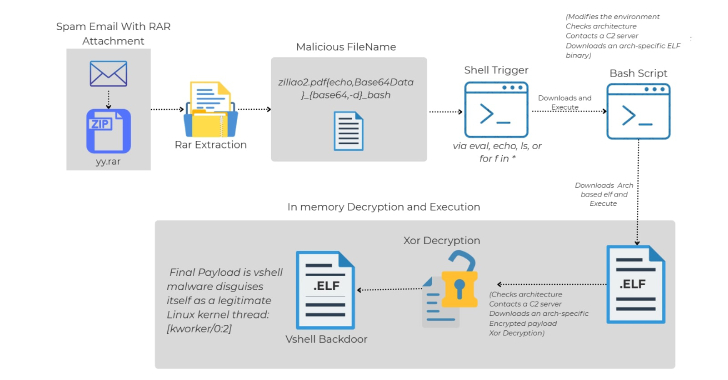
Researchers studying cybersecurity have revealed a new attack chain that uses phishing emails to spread the open-source backdoor VShell. According to a technical article by Trellix researcher Sagar Bade, the malware attack chain that is unique to Linux begins with a spam email that contains a malicious RAR archive file. The payload is encoded in the filename itself; it is not concealed within the file content or a macro. The attacker transforms a straightforward file listing process into an automatic malware execution trigger by deftly utilizing shell command injection and Base64-encoded Bash payloads. The cybersecurity firm added that the method exploits a straightforward but risky pattern frequently seen in shell scripts that occurs when file names are evaluated with insufficie...
New Koske Linux malware hides in cute panda images
News

New Koske Linux malware hides in cute panda images

Koske is a new piece of Linux malware that may have been created using artificial intelligence. It uses harmless-looking JPEG pictures of panda pandas to insert malware straight into the system memory. After analyzing Koske, researchers from the cybersecurity firm AquaSec called it "a sophhisticated Linux threat." The researchers think that the malware was created utilizing automation frameworks or large language models (LLMs) based on the adaptive behavior they saw. In order to mine more than 18 different coins, Koske plans to install CPU and GPU-optimized cryptocurrency miners that make use of the host's processing power. The attacks' Serbian IP addresses, the scripts' Serbian phrases, and the miners' GitHub repository's Slovak language were all recognized by AquaSec, but it wa...
New Linux Malware ‘sedexp’ Hides Credit Card Skimmers Using Udev Rules
News

New Linux Malware ‘sedexp’ Hides Credit Card Skimmers Using Udev Rules

Researchers studying cybersecurity have discovered a new, cunning piece of Linux malware that conceals credit card skimmer code and uses an unusual method to remain active on affected devices. The malware has been given the codename "sedexp" by Aon's Stroz Friedberg incident response services team, who believes it was created by a financially motivated threat actor. Researchers Zachary Reichert, Daniel Stein, and Joshua Pivirotto said that this advanced threat, which has been operational since 2022, lurks in plain sight while giving attackers access to sophisticated camouflage techniques and reverse shell capabilities. It should come as no surprise that malevolent actors are always modifying and honing their craft and have resorted to cutting-edge methods to avoid discovery read ...
New BIFROSE Linux Malware Variant Using Deceptive VMware Domain for Evasion
News

New BIFROSE Linux Malware Variant Using Deceptive VMware Domain for Evasion

Researchers studying cybersecurity have uncovered BIFROSE, also known as Bifrost, a new Linux version of a remote access trojan (RAT) that impersonates VMware on its false domain. Anmol Maurya and Siddharth Sharma, researchers from Palo Alto Networks Unit 42, stated that the goal of the most recent version of Bifrost is to sneak around security barriers and infiltrate specific systems. One of the persistent threats that has been operational since 2004 is BIFROSE. It has previously been offered for sale in underground forums for as much as $10,000, according to a December 2015 Trend Micro analysis. A state-sponsored hacking outfit from China known as BlackTech read more New BIFROSE Linux Malware Variant Using Deceptive VMware Domain for Evasion. Get up to date on the latest cyb...
New SprySOCKS Linux malware used in cyber espionage attacks
News

New SprySOCKS Linux malware used in cyber espionage attacks

A new Linux backdoor known as "SprySOCKS" was utilized by a Chinese hacker with a focus on espionage to target government entities in several different nations. With many of its features adapted to work on Linux systems, Trend Micro's study of the innovative backdoor revealed that it derives from the Trochilus open-source Windows malware. The SprySOCKS command and control server (C2) communication protocol is similar to RedLeaves, a Windows backdoor, hence the virus appears to be a mashup of several infections. The interactive shell's implementation, however, seems to have been inspired by the Linux malware Derusbi read more SprySOCKS Linux malware used in cyber espionage attacks. Stay informed with the best cybersecurity news and raise your cybersecurity awareness with our compr...
Reptile Rootkit Advanced Linux Malware Targeting South Korean Systems
News

Reptile Rootkit Advanced Linux Malware Targeting South Korean Systems

The open-source Reptile rootkit is being used by threat actors to target Linux systems in South Korea. Reptile offers a reverse shell, which enables threat actors to quickly take control of systems, in contrast to other rootkit malware that normally just provides hiding capabilities, according to a research released this week by the AhnLab Security Emergency Response Centre (ASEC). "Port knocking is a technique when malware on an infected system opens a certain port and then goes on standby. The magic packet that the threat actor transmits to the system is then utilized as the foundation for a connection to the C&C server read more Reptile Rootkit Advanced Linux Malware Targeting South Korean Systems. Stay informed with the best cybersecurity news and raise your cybersecurity...