Tag: Phishing Emails

Robinhood account creation flaw abused to send phishing emails
News

Robinhood account creation flaw abused to send phishing emails

Threat actors used the account creation procedure on the online trading site Robinhood to insert phishing messages into authentic emails, leading customers to believe their accounts had suspicious activity. Customers of Robinhood started getting "Your recent login to Robinhood" emails yesterday night, informing them that a "Unrecognized Device Linked to Your Account" with odd IP addresses and partial phone numbers had been found. After reading the phishing email, we discovered an attempt to log in from an unidentified device. Please check your account activity right away to secure your account if this wasn't you. The email contained a "Review Activity Now" button that directed users to the now-defunct phishing website at robinhood[.]casevaultreview[.]com. Reddit screenshots, h...
n8n Webhooks Abused Since October 2025 to Deliver Malware via Phishing Emails
News

n8n Webhooks Abused Since October 2025 to Deliver Malware via Phishing Emails

Threat actors have been seen using n8n, a well-known artificial intelligence (AI) workflow automation tool, as a weapon to enable complex phishing campaigns and send automated emails that transmit malware payloads or fingerprint devices. According to an analysis released today by Cisco Talos researchers Sean Gallagher and Omid Mirzaei, these attackers circumvent conventional security filters by using trusted infrastructure, transforming productivity tools into delivery vehicles for permanent remote access. N8n is a platform for workflow automation that enables users to connect different web apps, APIs, and AI model services in order to conduct recurring rule-based processes, create agentic systems, and sync data. To use a managed cloud-hosted service and automate workflows withou...
Phantom Stealer Spread by ISO Phishing Emails Hitting Russian Finance Sector
News

Phantom Stealer Spread by ISO Phishing Emails Hitting Russian Finance Sector

Cybersecurity experts have revealed information on an ongoing phishing attempt that targets several Russian industries using phishing emails that use malicious ISO optical disc images to deploy Phantom Stealer. The action, which Seqrite Labs nicknamed Operation MoneyMount-ISO, has mostly targeted finance and accounting organizations, with payroll, legal, and procurement verticals emerging as secondary targets. According to the cybersecurity firm, this operation uses a phony payment confirmation enticement to spread the Phantom information-stealing malware via a multi-stage attachment chain. Phishing emails that pose as authentic financial correspondence and ask recipients to verify a recent bank transfer are the first step in the infection chain. A ZIP archive that seems to have ...
iCloud Calendar abused to send phishing emails from Apple’s servers
News

iCloud Calendar abused to send phishing emails from Apple’s servers

iCloud Calendar invites are being misused to send callback phishing emails that seem like purchase notifications straight from Apple's email servers. This increases the likelihood that the emails will get past spam filters and reach their intended recipients' inboxes. A reader sent BleepingComputer an email earlier this month claiming to be a payment receipt for $599 that had been charged to the recipient's PayPal account. If the recipient wanted to talk about the payment or make modifications, this email offered a phone number. Good day, client Payment of $599.00 has been made to your PayPal account. Please check the email to ensure that we have received your most recent payment. In order to discuss or modify this payment, please give our support staff a call at (786) 902-8579. ...
New Malware Campaign Uses Cloudflare Tunnels to Deliver RATs via Phishing Chains
News

New Malware Campaign Uses Cloudflare Tunnels to Deliver RATs via Phishing Chains

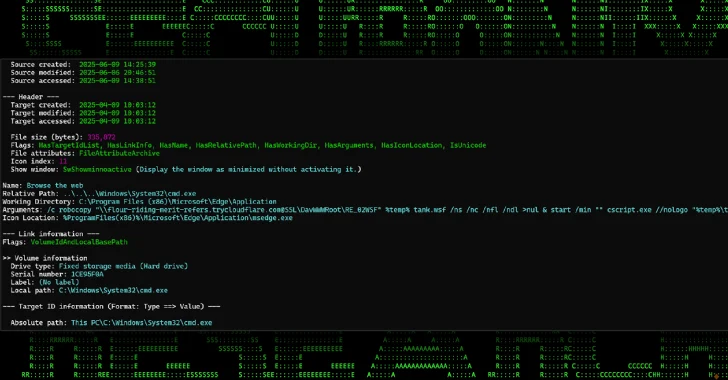
Cloudflare Tunnel subdomains are being used by a new campaign to host malicious payloads, which are then distributed through malicious attachments included in phishing emails. Securonix has given the ongoing campaign the codename SERPENTINE#CLOUD. "The Cloudflare Tunnel infrastructure and Python-based loaders are utilized to deliver memory-injected payloads through a chain of shortcut files and obfuscated scripts," according to a report that security researcher Tim Peck provided with The Hacker News. Phishing emails with an invoice or payment theme and a link to a zipped document containing a Windows shortcut (LNK) file are the first step in the attack. By posing as papers, these shortcuts deceive victims into opening them, so starting the infection chain. A Python-based shellcod...
North Korea ramps up cyberspying in Ukraine to assess war risk
News

North Korea ramps up cyberspying in Ukraine to assess war risk

The state-sponsored North Korean threat group Konni (Opal Sleet, TA406) was seen conducting intelligence gathering operations against Ukrainian government organizations. Phishing emails that mimic think tanks are used by the attackers to entice their targets by making references to significant military or political events. The activity was uncovered in February 2025 by Proofpoint researchers, who said it is probably an attempt to assess the political situation underlying the crisis and promote the DPRK's military engagement with Russia in Ukraine. In order to better comprehend the will to fight against the Russian invasion and evaluate the conflict's medium-term perspective, Proofpoint evaluates TA406's targeting of Ukrainian government agencies read more about North Korea ramps ...
Horabot Malware Targets 6 Latin American Nations Using Invoice-Themed Phishing Emails
News

Horabot Malware Targets 6 Latin American Nations Using Invoice-Themed Phishing Emails

Researchers studying cybersecurity have found a new phishing effort that targets Windows users in Latin American nations like Mexico, Guatemala, Colombia, Peru, Chile, and Argentina with malware named Horabot. The campaign can gather contact lists, install banking trojans, and steal email passwords by utilizing carefully constructed emails that seem like invoices or financial documents to fool victims into opening harmful attachments. Cara Lin, a researcher at Fortinet FortiGuard Labs, stated. The network security firm first noticed the behavior in April 2025, and it has mostly targeted people who speak Spanish. Additionally, it has been discovered that the assaults use Outlook COM automation to send phishing messages from victims' mailboxes, thereby laterally spreading the virus ac...
Phishing emails increasingly use SVG attachments to evade detection
News

Phishing emails increasingly use SVG attachments to evade detection

Scalable Vector Graphics (SVG) attachments are being used more often by threat actors to distribute malware or show phishing forms without being discovered. JPG and PNG files, which are composed of grids of tiny squares called pixels, make up the majority of photos on the internet. The entire image is made up of pixels, each of which has a distinct color value. Scalable Vector Graphics, or SVG, uses lines, shapes, and text that are described in textual mathematical formulas in the code to make graphics rather than pixels read more about Phishing emails increasingly use SVG attachments to evade detection. Get up to date on the latest cybersecurity news and enhance your knowledge of cybersecurity with our thorough coverage of the dangers, breaches, and solutions.
Russian Hackers Exploit New NTLM Flaw to Deploy RAT Malware via Phishing Emails
News

Russian Hackers Exploit New NTLM Flaw to Deploy RAT Malware via Phishing Emails

A suspected actor with ties to Russia used a recently patched security hole in Windows NT LAN Manager (NTLM) as a zero-day exploit in cyberattacks against Ukraine. CVE-2024-43451 (CVSS score: 6.5) is a vulnerability that might be used to obtain a user's NTLMv2 hash. It is an NTLM hash disclosure spoofing vulnerability. Microsoft corrected it early this week. According to Microsoft's advisory, this vulnerability could be activated by a user choosing (single-clicking), inspecting (right-clicking), or doing an action other than opening or running a malicious file read more about Russian Hackers Exploit New NTLM Flaw to Deploy RAT Malware via Phishing Emails. Get up to date on the latest cybersecurity news and enhance your knowledge of cybersecurity with our thorough coverage of the ...