Tag: Malware attack

North Korea-Linked Malware Targets Developers on Windows, Linux, and macOS
News

North Korea-Linked Malware Targets Developers on Windows, Linux, and macOS

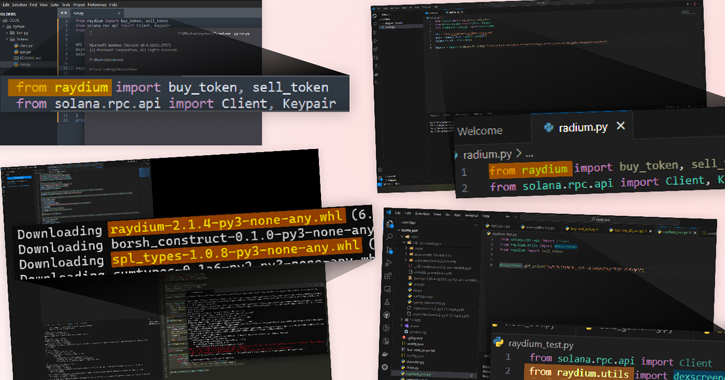
The threat actors responsible for a persistent campaign of malware directed on software developers have showcased novel malware and strategies, broadening their scope to encompass Windows, Linux, and macOS operating systems. It has been discovered that the North Korean-affiliated activity cluster, known as DEV#POPPER, has targeted victims in South Korea, North America, Europe, and the Middle East. Securonix researchers Den Iuzvyk and Tim Peck described this type of attack as an advanced form of social engineering, intended to coerce people into disclosing private information or taking actions against their better judgment. They made these claims in a recent article that was shared with The Hacker News. An ongoing malware operation known as DEV#POPPER lures software developers rea...
PHP Vulnerability Exploited to Spread Malware and Launch DDoS Attacks
News

PHP Vulnerability Exploited to Spread Malware and Launch DDoS Attacks

A recently discovered PHP security vulnerability has been reported to be used by a number of threat actors to propagate distributed denial-of-service (DDoS) botnets, bitcoin miners, and remote access trojans. The CVE-2024-4577 vulnerability (CVSS score: 9.8) in question gives an attacker the ability to remotely execute malicious commands on Windows computers that are configured with Chinese and Japanese language locales. It was made known to the public in early June 2024. Researchers at Akamai, Kyle Lefton, Allen West, and Sam Tinklenberg, identified a vulnerability called CVE-2024-4577 that lets an attacker bypass the command line and pass arguments that are parsed directly by PHP. They made this discovery on Wednesday. "The method used to translate Unicode characters into ASCII is...
Hackers attack HFS servers to drop malware and Monero miners
News

Hackers attack HFS servers to drop malware and Monero miners

Hackers are deploying malware and cryptocurrency mining software on outdated Rejetto HTTP File Server (HFS) versions. The threat actors, according to threat experts at security firm AhnLab, are taking use of a critical-severity security flaw called CVE-2024-23692, which permits the execution of arbitrary commands without the requirement for authentication. Versions of the program up to and including 2.3m are vulnerable. Rejetto informs users via a notice on their website that versions 2.3m through 2.4 are "dangerous and should not be used anymore" due to an issue where an attacker can "control your computer," and that a solution is still pending. Attacks on version 2.3m of HFS, which is still widely used by lone people, small groups, academic institutions, and developers wishing ...
GootLoader Malware Still Active, Deploys New Versions for Enhanced Attacks
News

GootLoader Malware Still Active, Deploys New Versions for Enhanced Attacks

Threat actors are still actively using the malware known as GootLoader in an effort to infect more hosts with malware. GootLoader has been released in multiple versions due to changes to its payload; the most recent version, GootLoader 3, is presently in use, according to a study released last week by cybersecurity company Cybereason. The general functioning and infection techniques of GootLoader payloads have not altered since the malware's 2020 revival, despite certain payload details changing over time. GootLoader, a malware loader that is a component of the Gootkit financial trojan, has been associated with Hive0127, also known as UNC2565. It is disseminated by search engine optimization (SEO) poisoning techniques and employs malicious JavaScript read more about GootLoader Ma...
FakeBat Loader Malware Spreads Widely Through Drive-by Download Attacks
News

FakeBat Loader Malware Spreads Widely Through Drive-by Download Attacks

According to research from Sekoia, the loader-as-a-service (LaaS) family of loader malware known as FakeBat has grown to be one of the most popular loader malware families disseminated via drive-by download this year. The business stated in a Tuesday report that "the primary goal of FakeBat is to download and execute the next-stage payload, such as IcedID, Lumma, RedLine, SmokeLoader, SectopRAT, and Ursnif." Drive-by assaults involve tricking users into downloading fake software installers or browser upgrades by means of techniques including malvertising, search engine optimization (SEO) poisoning, and malicious code injections into compromised websites. Over the past few years, there has been an increasing trend in the usage of malware loaders in tandem with landing pages that p...
Europol Shuts Down 100+ Servers Linked to IcedID, TrickBot, and Other Malware
News

Europol Shuts Down 100+ Servers Linked to IcedID, TrickBot, and Other Malware

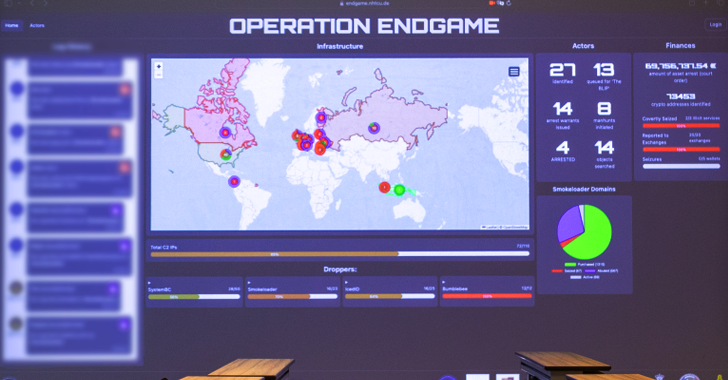
As part of a concerted law enforcement operation known as Operation Endgame, Europol claimed on Thursday that it had shut down the infrastructure connected to multiple malware loader operations, including IcedID, SystemBC, PikaBot, SmokeLoader, Bumblebee, and TrickBot. "The actions focused on disrupting criminal services through arresting High Value Targets, taking down the criminal infrastructures and freezing illegal proceeds," Europol stated in a statement. "The malware […] facilitated attacks with ransomware and other malicious software." In the course of searches conducted at 16 locations in Armenia, the Netherlands, Portugal, and Ukraine, the action, which took place between May 27 and 29, resulted in the dismantling of over 100 servers globally and the arrest of four individu...
JAVS courtroom recording software backdoored in supply chain attack
News

JAVS courtroom recording software backdoored in supply chain attack

Malware has been used to backdoor the installation of Justice AV Solutions (JAVS), a popular courtroom video recording program, allowing attackers to gain control of affected PCs. The digital recording technology, commonly referred to as JAVS, is presently installed in over 10,000 courtrooms, law offices, penal facilities, and other entities globally, according to the company that created it. Since then, JAVS has taken down the compromised version from its official website, claiming that the malicious fffmpeg.exe component that was part of the trojanized program "did not come from JAVS or any 3rd party related to JAVS." To make sure that, in the unlikely event that they were stolen, the organization reset all passwords and performed a thorough examination of all systems read more...
Malware Delivery via Cloud Services Exploits Unicode Trick to Deceive Users
News

Malware Delivery via Cloud Services Exploits Unicode Trick to Deceive Users

A fresh attack campaign known as CLOUD#REVERSER has been seen staging malware payloads using reputable cloud storage services like Dropbox and Google Drive. Securonix researchers Den Iuzvyk, Tim Peck, and Oleg Kolesnikov stated in a report shared with The Hacker News that the VBScript and PowerShell scripts in the CLOUD#REVERSER inherently involve command-and-control-like activities by using Google Drive and Dropbox as staging platforms to manage file uploads and downloads. Because the scripts are made to retrieve files that fit particular patterns, it is possible that they are awaiting instructions or scripts that have been stored in Dropbox or Google Drive. A phishing email containing a ZIP archive file, which contains an executable that poses as a Microsoft Excel file, is the ...
Ebury Botnet Malware Compromises 400,000 Linux Servers Over Past 14 Years
News

Ebury Botnet Malware Compromises 400,000 Linux Servers Over Past 14 Years

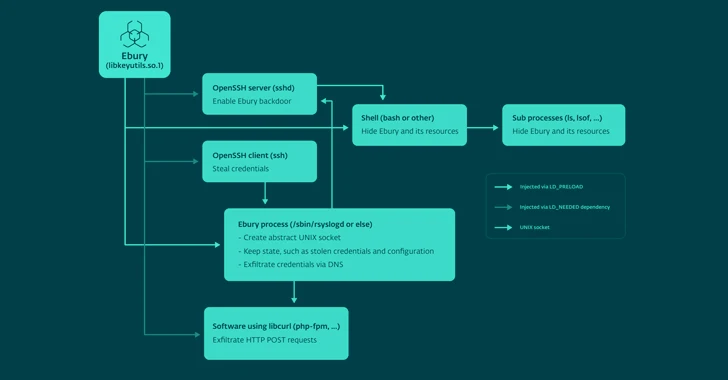
Since 2009, a malware botnet known as Ebury is thought to have infected 400,000 Linux systems; as of late 2023, over 100,000 of those machines remained affected. The Slovak cybersecurity company ESET released the findings, calling it one of the most sophisticated server-side malware campaigns for financial benefit. According to a thorough investigation by security researcher Marc-Etienne M. Léveillé, "Ebury actors have been pursuing monetization activities […], including the spread of spam, web traffic redirections, and credential theft." In addition, the operators engage in bitcoin thefts through the use of AitM and credit card theft by network traffic eavesdropping, also referred to as server-side web skimming. Ebury was first discovered more than ten years ago as a componen...
Hijack Loader Malware Employs Process Hollowing, UAC Bypass in Latest Version
News

Hijack Loader Malware Employs Process Hollowing, UAC Bypass in Latest Version

A more recent iteration of the malware loader known as Hijack Loader has been seen to use a revised set of anti-analysis strategies to evade detection. In a technical study, Zscaler ThreatLabz researcher Muhammad Irfan V A stated that the goal of these improvements is to make the virus more stealthy so that it can evade detection for longer periods of time. The most recent versions of Hijack Loader come with modules that allow users to disable User Account Control (UAC), create an exclusion for Windows Defender Antivirus, avoid inline API hooking—which security software frequently uses to detect malicious activity—and leverage process hollowing. In September 2023, the cybersecurity group published its first report on Hijack Loader, also known as IDAT Loader, a malware loader read...